Positioning
Infrastructure™
The Science of Market Selectability
A Strategic Discipline for Human & AI Buyer Selection.
The Hidden Advantage.
Positioning Infrastructure™ is the strategic foundation that determines whether your product is understood, trusted, evaluated, and ultimately selected by both human buyers and AI-driven buying systems.
The position you don't operate is the position you don't have.
Positioning Infrastructure – the discipline of running your position continuously, in a B2B market that moves every day.
Something has shifted in how B2B deals get decided.
Your buyers are researching before you know they exist. They’re building shortlists in AI tools your team can’t observe. They’re being handed vendor comparisons by machines that don’t read the content your marketing team is producing. By the time a deal reaches your pipeline — if it reaches it at all — the decision has largely been made.
Your dashboards look green. Your brand awareness looks stable. Your positioning has drifted out from under you, in surfaces no one was watching.
What it is
Positioning Infrastructure maintains your company’s position – in the minds of human buyers and the representations of the AI evaluators they now consult – against a market that no longer sits still.
The older discipline treated positioning as an artifact.
A statement. A framework.
A refresh cycle.
You built it, deployed it, moved on.
Who it's for
B2B Founders
and CEOs
Who sense their category work is aging faster than it used to. PE operating partners with B2B portfolio responsibility. Functional executives in Finance, HR, IT, Legal, and Operations who own positioning for their functions.
Senior B2B
Marketing Leaders
CMOs, VPs of Marketing, senior product marketing leaders, category strategy owners — at enterprise and growth-stage companies whose pipelines have started softening for reasons the existing dashboards can’t explain.
Industry Analysts, Business Press, and Category-Creation Advisors
Whose engagements are being pulled into this territory by client demand.
If you’ve noticed AI tools describing your company inaccurately, or competitors winning positions you should own, or pipeline gaps you can’t trace.
The positioning infrastructure is for you.
Why now
Three permanent conditions have shifted together.
01.
The decisive moment in a B2B deal has moved earlier.
According to 6sense’s 2025 Buyer Experience Report, roughly 95 percent of B2B purchases are effectively decided before a sales conversation begins. Forrester’s 2025 research confirms the same pattern in enterprise technology. The shortlist is being assembled in an interval traditional marketing instruments don’t measure.
02.
Machine evaluators now shape that
pre-contact interval.
The same 6sense study found that 94 percent of B2B buyers use large language models during their buying process. What used to be peer consultation, analyst calls, and search research has migrated into buyer-to- machine consultation.
03.
Trust signal architecture
Competitors publish daily. Analysts update in real time. Machines re-index constantly. Buyers evaluate whenever they have five minutes. A position that isn’t operated against that movement decays at a measurable rate.
None of these three conditions is going to reverse.
The architecture
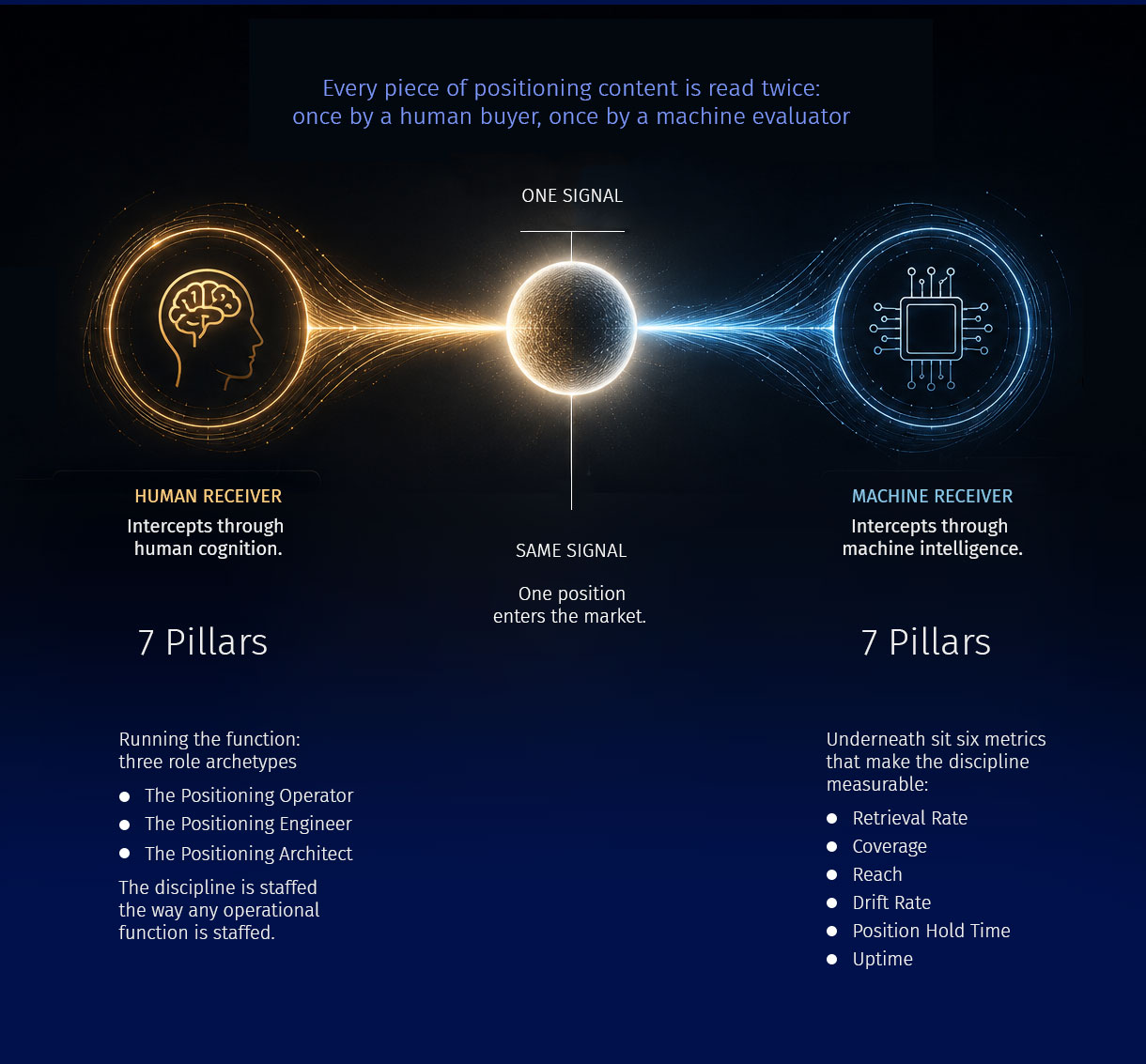
The Two Receivers. Every piece of positioning content is now read twice — once by a human buyer, once by a machine evaluator. Both readers evaluate continuously. Both operate on different mechanisms. Both must be addressed.
Below the Two Receivers sit fourteen pillars — seven for the human receiver, seven for the machine receiver. Each names a specific mechanism by which a position holds or fails. The Short List Gate. The Spec Shadow. The Surface Split. The Second Voice. Fourteen operable levers, each with a diagnostic, a failure mode, and an operational response.
Unifying it: the Signal Path, a framework drawn from Claude Shannon and Warren Weaver’s 1948 communication model. The human and machine receivers, though operating on different substrates, obey the same underlying physics.
One physics. Two receivers. Fourteen levers.

What exists today,
and why it isn't enough
Three adjacent disciplines occupy nearby territory.
Classical positioning is the foundational literature. It defined the discipline for a world in which the position could be set and held between refreshes. That world was real; the discipline was correct for it. What has changed is the operating environment.
Content marketing and brand practice communication continuously, but not against a specific position. They serve positioning; they aren’t positioning.
Answer Engine Optimization and Generative Engine Optimization address the machine receiver as an isolated technical problem. Necessary work, but detached from the human receiver and from strategic positioning.
What you do with it
Run the fourteen-question diagnostic on your own organization in an afternoon. The audit produces a specific inventory of failures in the language of the discipline — where your Spec Shadow is costing you comparisons, where your Surface Split is diluting machine confidence, where your Trust Drop is making your strongest claims your least believed.
Take that inventory
upward.
The vocabulary gives you language your CFO will understand at budget review and your CEO will understand at the board update.
Design the function your
organization doesn’t yet have.
The three role archetypes tell you what to staff. The operating cadence tells you how to run it.
Measure
continuously.
The six metrics produce the dashboard that reveals what your existing instruments miss.
Fund the discipline in the operational-infrastructure register — the same register that funded your security function in 1999 and your data governance function in 2013.
Where the category is going
The vocabulary of Positioning Infrastructure is being set in 2026.
The companies that adopt the discipline early will compound advantage over the next decade — the same way early adopters of continuous security and site reliability did in their eras. The companies that don’t will keep explaining softening pipelines to boards that have stopped accepting the older explanations.
Xclaymation built this discipline through client engagements with Fortune 500 companies across cybersecurity, industrial technology, legal information, specialty manufacturing, retail, and financial services.
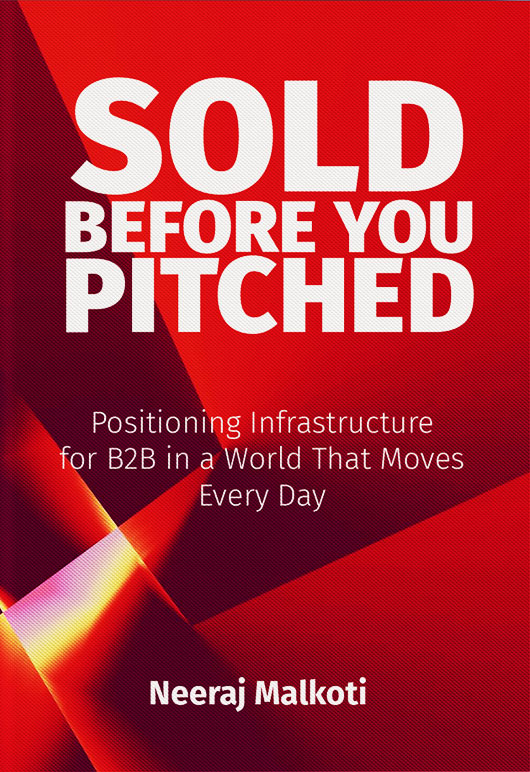
The framework is documented in the forthcoming book:
The Substack
positioninginfrastructure.substack.com
develops individual pillars and metrics in longer form.
Start with the X!MCO Readiness Audit
Before engaging X!Vector, we run a complimentary X!MCO Readiness Audit – a 48-hour benchmark of how your product currently shows up when AI agents evaluate vendors in your category.
One question matters: will an AI agent choose your product when no human is watching?